
Resource Download
SMSF Investment Strategy Template
A structured, plain-English template built for SMSF trustees. Covers every mandatory element under the SIS Act, with prompts to document your portfolio rationale and satisfy your annual review obligation.
- Addresses all SIS Act s.52B trustee obligations
- Includes risk profile, diversification and liquidity sections
- Guided prompts for member-specific circumstances
- Structured around Modern Portfolio Theory principles
- Compatible with your accountant and SMSF auditor workflow.
The ATO's Investment Strategy Requirement
Every SMSF in Australia is legally required to maintain a current, written investment strategy. Understanding what that means - and what it costs if you don't - is the starting point for every trustee.
$1.1T
Under SMSF Management
Australia's 610,000+ SMSFs collectively manage more than $1.1 trillion in assets, making the sector the largest single segment of Australia's $3.9 trillion superannuation system.
(APRA Annual Superannuation Bulletin, 2024)s.52B
SIS Act Obligation
Section 52B of the Superannuation Industry (Supervision) Act 1993 requires trustees to formulate, review regularly, and give effect to a written investment strategy, not merely hold one on file.
(SIS Act 1993 (Cth), s.52B(2)(f))45%
Non-complying Tax Rate
A fund found to be non-complying by the ATO loses its 15% concessional tax rate. Instead, the fund is taxed at 45% on all income and assets - a penalty that can eliminate years of accumulated growth.
(ATO, SMSF compliance obligations, 2024)Designed for three types of SMSF Trustees
Whether you self-manage your fund from scratch or work with an accountant or adviser, this template is structured to fit your workflow.
✅
The Self-directed Trustee
You manage your SMSF independently and handle your own compliance documentation. You know your fund's investments well but want a structured framework to ensure you haven't missed a mandatory requirement.
"I need a document I can complete myself, without paying a financial adviser for a strategy review every year."✅
The Trustee Working With an Accountant
Your accountant handles your SMSF's tax return and audit preparation. You want to come to your annual meeting with a draft strategy already completed, saving time and reducing professional fees.
"My accountant charges by the hour. If I can complete most of this myself, I can keep the meeting focused on the important decisions."✅
The Professional Adviser (Client Template)
You are an accountant, financial planner or SMSF specialist who prepares investment strategies for multiple client funds. The template provides a consistent, reusable structure you can customise per client.
"I need a template I can white-label and adapt for different client risk profiles without starting from a blank page each year."SMSF Investment Strategy - Frequently Asked Questions
How often must SMSF trustees review their investment strategy?
Under section 52B of the Superannuation Industry (Supervision) Act 1993 (SIS Act), SMSF trustees must review their investment strategy regularly. The ATO guidance states this means at least annually, and also whenever a significant change occurs, such as a member approaching retirement, a large contribution being received, or a change in fund membership.
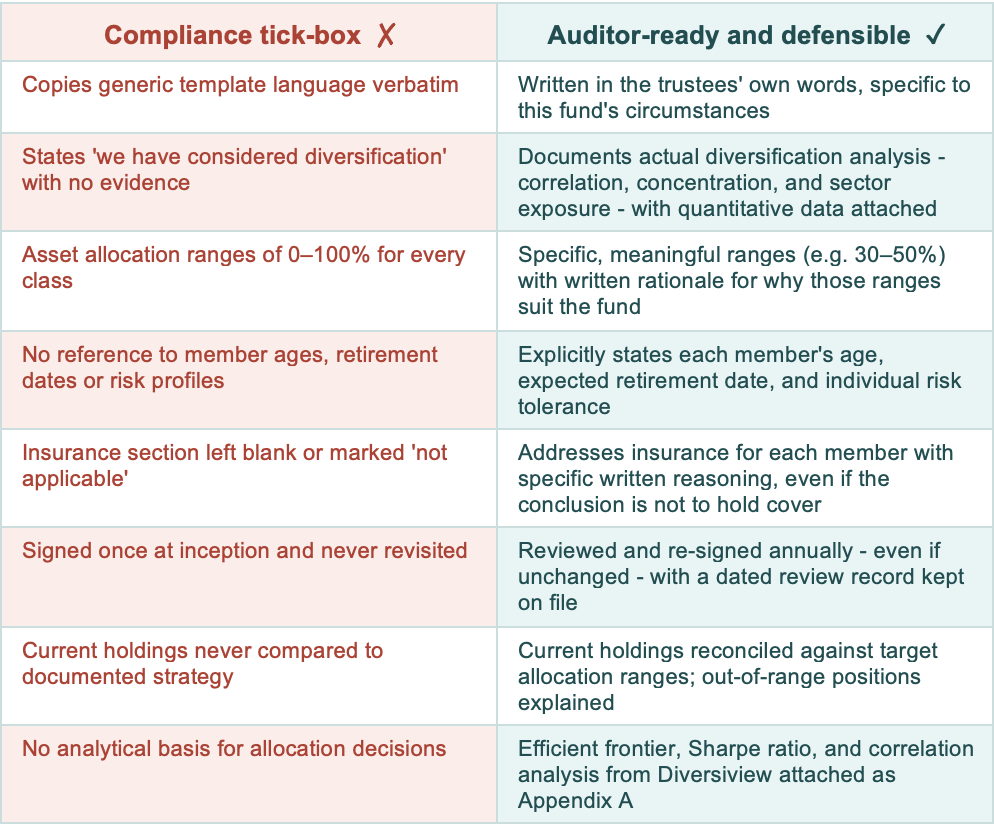
A strategy dated from a prior year that has not been reviewed will not satisfy an SMSF auditor.
What must an SMSF investment strategy include under the SIS Act?
The SIS Act requires an SMSF investment strategy to address four core areas:
(1) the risk and likely return from the fund's investments, in light of the fund's objectives and expected cash flow requirements;
(2) the composition of the fund's investments, including diversification across asset classes;
(3) the fund's liquidity, having regard to expected pension payments and lump sum withdrawals; and
(4) whether the trustees should hold life insurance for members within the fund.
Is a generic SMSF investment strategy template compliant?
What are the consequences of not having a written investment strategy?
Failing to maintain a current, written investment strategy is a breach of the SIS Act. If identified during an audit, the auditor is required to report the contravention to the ATO. The ATO may issue administrative penalties to individual trustees or, in serious cases, issue a notice of non-compliance - which causes the fund to be taxed at 45% on all income and assets for that financial year, rather than the concessional 15% rate.
How does portfolio analysis support an SMSF investment strategy?
A well-documented SMSF investment strategy requires trustees to articulate their asset allocation rationale, assess diversification, and demonstrate that investment decisions are consistent with the fund's risk/return objectives.
Portfolio analysis tools - such as Diversiview - help trustees quantify these positions using Modern Portfolio Theory frameworks: efficient frontier analysis, correlation matrices, and concentration metrics.
This data can be referenced directly in the strategy document and supports the auditor's verification of alignment between the documented strategy and actual investment behaviour.
Can the same investment strategy document cover multiple financial years?
Yes - provided the strategy is genuinely reviewed and updated each year.
The LENSELL template includes an Annual Review & Amendment Log section specifically designed for this purpose. Trustees record what was reviewed, what changed (if anything), and sign off each year. This maintains a single, version-controlled document rather than creating a new file annually, and provides a clear audit trail for the SMSF auditor.